

In the competitive SaaS marketing landscape, traditional SEO is no longer enough. Search is rapidly changing. AI tools like Google’s AI Overviews and chatbots now answer user questions directly in the search results. For SaaS companies, this means your potential customers might get the information they need without ever visiting your website.
This shift calls for a new approach: generative AI SEO. Also known as Generative Engine Optimization (GEO), this strategy is the key to maintaining visibility and driving high-quality leads in the age of AI.
The Shift from Traditional SEO to Generative AI SEO
For years, SEO focused on ranking your website in the “10 blue links” on a search results page. But generative AI is changing user behavior. Instead of clicking links, users are getting direct, synthesized answers from the search engine itself.
This creates a significant risk for SaaS companies. If users get answers without clicking, your website traffic can drop, leading to fewer leads and demos. The new goal is to evolve your strategy so that your brand becomes a cited, authoritative source within these AI-generated responses. This requires optimizing for AI-driven search to ensure your content is seen as a primary source of information.
What is Generative Engine Optimization (GEO)?
Generative Engine Optimization (GEO) is the practice of optimizing your website and content to be featured and cited within AI-driven search results. It’s about making your content so valuable and clear that AI models choose it to answer user questions.
At CSP Agency, we champion a Human-First approach to GEO. This philosophy combines the power of AI tools with the irreplaceable value of genuine human expertise. Our goal is to create strategies that deliver measurable business results, not just rankings or vanity metrics. We provide Human-First SEO, GEO, & Paid Media for eComm & B2B.
A successful GEO strategy for any SaaS company rests on three core pillars:
- Accessibility: This means ensuring AI crawlers can technically find, access, and understand the content on your website without any issues.
- Owned Media: This involves creating high-quality, expert-driven content on your own website that provides unique insights and comprehensively answers your audience’s questions.
- Earned Media: This pillar focuses on building external validation through mentions, reviews, and features in other trusted online publications to signal authority to AI engines.
The Data-Backed Case for Generative AI SEO
Adopting a GEO strategy isn’t just about keeping up with trends; it delivers a significant return on investment. The data shows that companies embracing generative AI SEO are achieving remarkable growth.
- One study revealed that companies implementing systematic GEO frameworks saw an 800% year-over-year increase in traffic from large language models [1].
- In another case, a company that specifically optimized its content for AI Overviews achieved a 2,300% increase in monthly AI referral traffic [2].
- An AI-driven content system helped another business grow its monthly revenue from $166k to $491k [3].
These figures prove that the goal of generative AI SEO isn’t just more traffic. It’s about driving tangible business outcomes like more qualified leads and higher revenue.
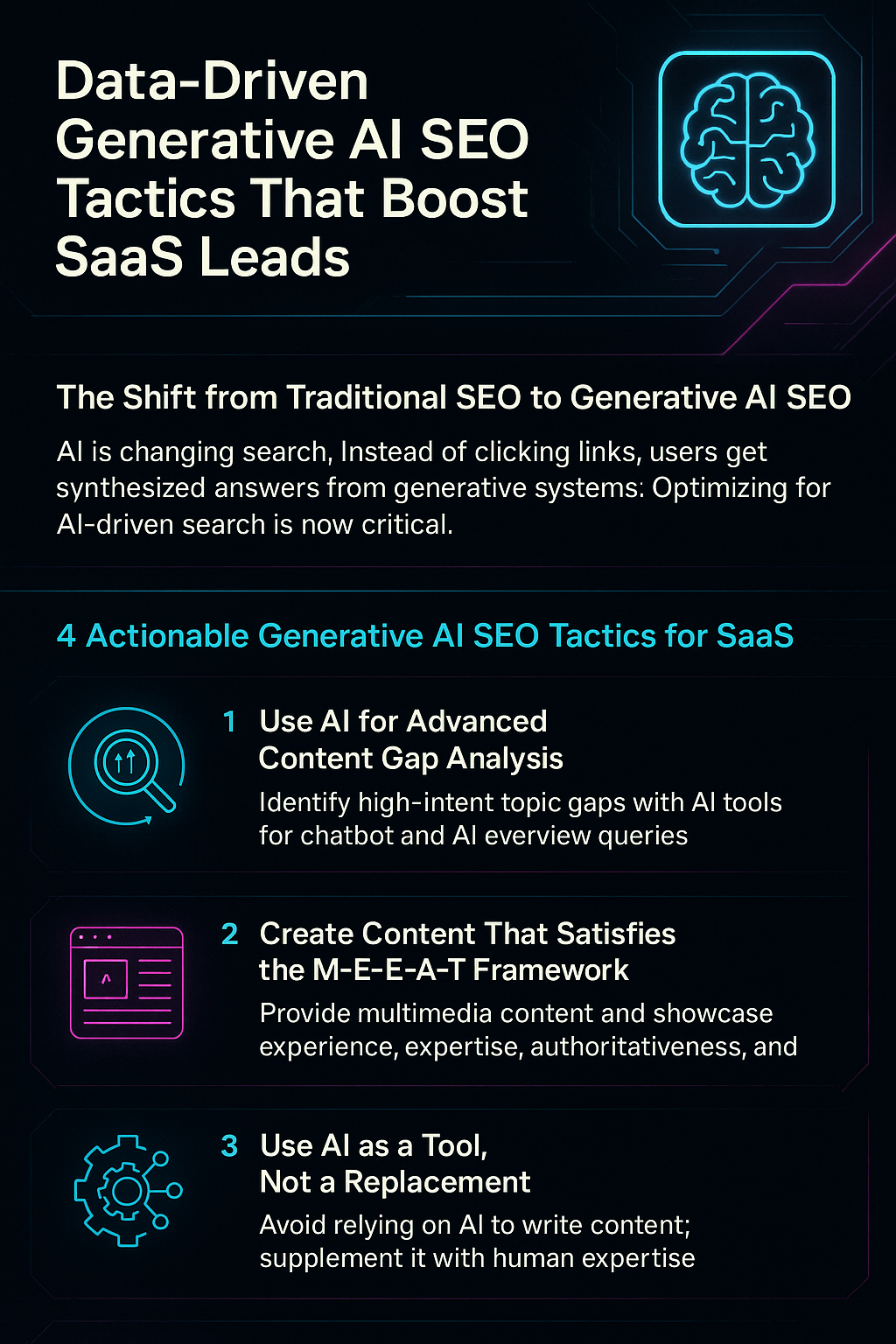
4 Actionable Generative AI SEO Tactics for SaaS
Ready to get started? Here are four data-driven tactics you can implement to adapt your SEO for the generative AI era.
Tactic 1: Use AI for Advanced Content Gap Analysis
It’s time to move beyond basic keyword research. Use AI tools to analyze the answers appearing in AI Overviews and chatbot results for your industry. This helps you understand the exact questions your target audience is asking.
By doing this, you can identify “topic gaps”—areas where your competitors are not providing sufficient answers, and where your SaaS solution can be perfectly positioned as the ideal solution. Using AI for this analysis allows you to pinpoint high-intent questions that lead to conversions [4]. This level of data-driven analysis is the foundation of a robust SEO strategy development plan.
Tactic 2: Create Content That Satisfies the M-E-E-E-A-T Framework
To stand out, your content must offer more than what AI can generate on its own. At CSP, we use the M-E-E-E-A-T framework, an expansion of Google’s E-E-A-T guidelines, to create high-value content.
- Multimedia & Engagement: AI struggles to create original videos, infographics, or interactive tools. By incorporating these elements, you create unique content that engages users and provides value that AI can’t easily replicate.
- Experience, Expertise, Authoritativeness, Trust (E-E-A-T): This is about proving your credibility. Showcase real-world experience from your team, feature author bios, and cite credible data. This builds trust with both human readers and AI models.
Following this framework is a core component of optimizing for AI-driven search and positioning your content as authoritative.
Tactic 3: Use AI as a Tool, Not a Replacement
Generative AI is a powerful assistant, but it’s not a content creator. Tools like ChatGPT are excellent for brainstorming ideas, structuring articles, and performing initial research. You can learn how to use ChatGPT for SEO to make your workflow more efficient.
However, relying on AI to write entire articles is a mistake. This approach has significant tradeoffs. AI-generated content often lacks the depth, nuance, and genuine expertise needed to connect with your audience and persuade them to become a lead. It can be inaccurate and risks damaging your brand’s credibility. At CSP Agency, our content creation services prioritize writing for your target audience first, using AI to enhance—not replace—our human expertise.
Tactic 4: Optimize for Entities with Structured Data
Generative AI thinks in terms of “entities”—the people, products, concepts, and places that make up a topic. It connects these entities to understand the world. To get featured in AI results, you need to help AI understand what your SaaS company is and what it does.
You can do this using structured data (also known as Schema markup). This is a piece of code you add to your website that explicitly defines your SaaS product, its features, pricing, and the problems it solves. This technical optimization helps AI models correctly understand your offerings, increasing your chances of being featured in relevant, bottom-of-funnel searches. A strong technical foundation is a key part of an effective AI SEO framework, helping one company achieve 4,162% traffic growth [5].
Conclusion: Future-Proof Your SaaS Lead Generation
To succeed in the new era of search, SaaS companies must embrace a data-driven, human-first GEO strategy. The days of focusing only on blue links are over. The future of lead generation depends on becoming a trusted, cited source within AI-powered answers.
This involves combining a solid technical foundation, expert-led content that showcases your unique experience, and a commitment to building brand authority. The companies that adopt these generative AI SEO tactics are already seeing significant growth in traffic, leads, and revenue.
Are you ready to build a business-aligned strategy for the AI-driven world? Explore CSP’s AI-focused strategies to learn how we can help you future-proof your lead generation.Citations
- [1] https://maximuslabs.ai/generative-engine-optimization/geo-case-studies-success-stories
- [2] https://diggitymarketing.com/ai-overviews-seo-case-study
- [3] https://diggitymarketing.com/ai-seo-genius-case-study
- [4] https://algocentric.ca/ai-powered-content-marketing-playbook
- [5] https://xponent21.com/insights/ai-seo-case-study-engineering-top-ai-ranks