

The digital landscape for B2B SaaS companies is shifting. Traditional SEO focused on ranking, but the rise of generative AI requires Generative Engine Optimization (GEO). While many marketers understand the technical need for structured data, few connect it directly to business value. This gap prevents them from securing the investment needed to compete.
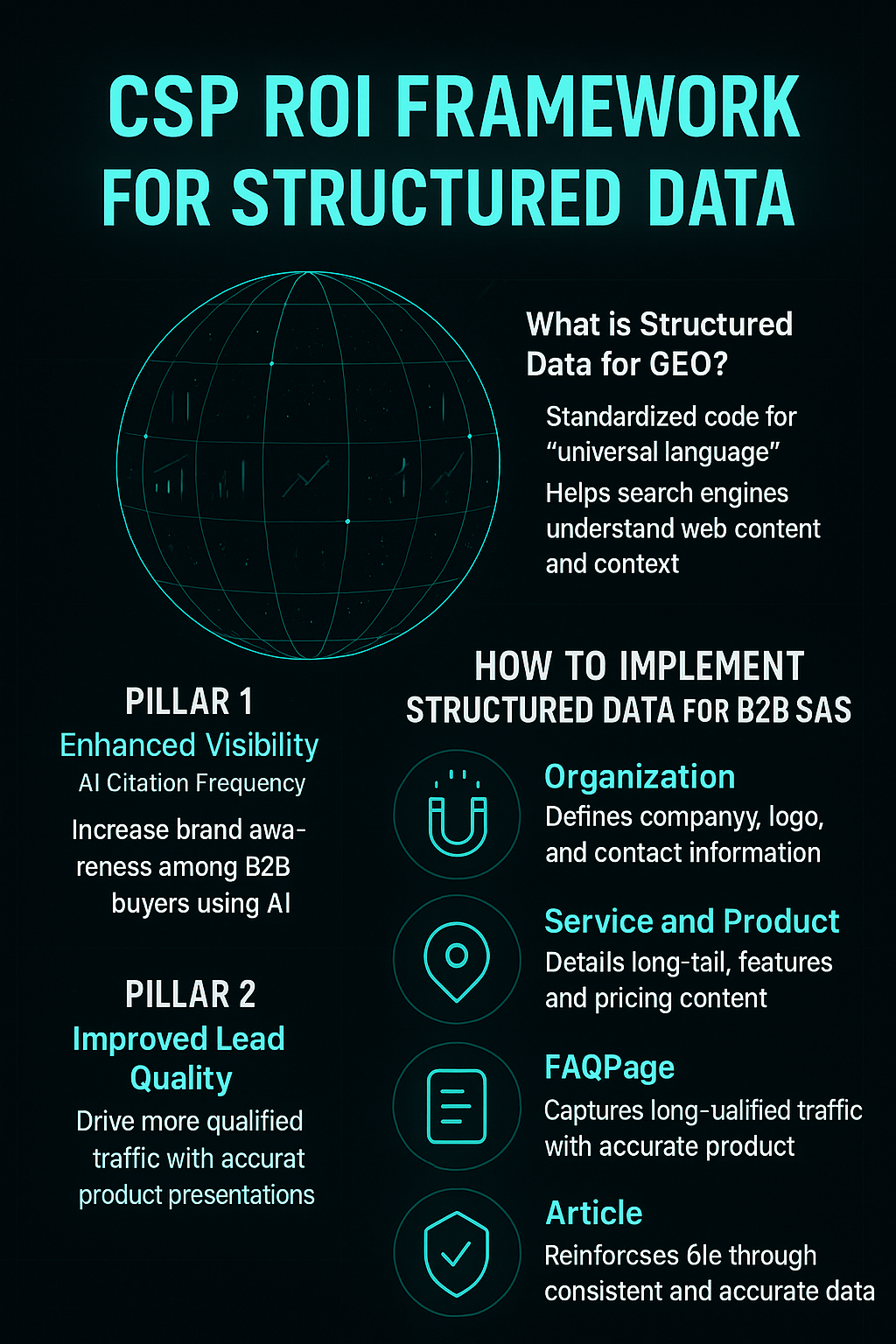
This article provides a clear ROI framework for implementing structured data for GEO. Structured data is a “universal language” that helps search engines understand your website’s content and context [1]. For B2B SaaS, this is a direct line of communication to the AI models influencing your buyers’ decisions.
What is Structured Data and Why is it Critical for GEO?
Structured data is a standardized code format that provides explicit clues to search engines and AI models about a page’s content [2]. It translates human-readable content into a machine-readable format, leaving no room for ambiguity.
In the age of GEO, this translation is critical. AI engines rely on this data to accurately understand, synthesize, and cite information in their generated answers. Without clear structured data, your SaaS platform’s features and value propositions risk being misinterpreted or ignored by AI systems.
Implementing structured data is a foundational element of making your content accessible to users and AI. It is a core component of the three pillars of Generative Engine Optimization.
The CSP ROI Framework: Connecting Structured Data to Business Value
At CSP Agency, we developed an ROI framework to help B2B SaaS companies measure the return from structured data initiatives. This model shifts the conversation from a technical task to a strategic driver. The framework is built on three pillars of measurable value: Enhanced Visibility, Improved Lead Quality, and Increased Authority.
Pillar 1: Enhanced Visibility and Citation Frequency
Properly implemented structured data helps your content get featured in AI-generated results. This increases what we call your “AI Visibility Score,” a measure of how often your brand appears in generative answers.
This leads to higher “Citation Frequency”—the number of times your brand is cited as the source in an AI response. This visibility drives top-of-funnel brand awareness among B2B buyers using AI for research. It is one of the most effective GEO tactics for B2B lead generation.
Pillar 2: Improved Lead Quality and Conversions
Clear, structured information allows AI to precisely match a user’s problem with your company’s solution. When an AI can accurately present your product’s features and pricing, the traffic driven to your site is inherently more qualified.
This pre-qualification results in higher conversion rates from generative and organic traffic. The user arrives with a clearer understanding of your offer, reducing friction in the sales funnel. Enhanced visibility in search is the first step, leading to more relevant traffic and better leads [3].
Pillar 3: Increased Authority and Trust (E-E-A-T)
Structured data is a powerful tool for reinforcing Expertise, Experience, Authoritativeness, and Trustworthiness (E-E-A-T) signals. Consistent and accurate data across your owned media builds credibility with AI models.
When generative engines consistently find accurate, well-structured information, they are more likely to trust and cite your content. This aligns directly with CSP’s advanced M-E-E-E-A-T content framework, where technical precision supports content authority.
A Practical Guide to Implementing Structured Data for B2B SaaS
Here are actionable steps for B2B SaaS marketers to implement structured data effectively.
Identify and Prioritize Key Schema Types
Focus your resources on the schema types most impactful for B2B SaaS.
Organization: Defines your company, logo, and official contact information.ServiceandProduct: Details your offerings, features, and pricing models.FAQPage: Captures long-tail conversational queries that users ask AI.Article: Specifies authors and publication dates for your blog content, reinforcing expertise.LocalBusiness: Essential for companies with physical offices or those serving specific geographic regions [4].
You can find practical guides on how to implement this schema for your business [5].
Choose the Right Format and Tools
JSON-LD is the format recommended by Google. It is generally easier to manage without altering your site’s HTML structure [6].
Before deploying, always validate your markup using tools like Google’s Rich Results Test or the Schema.org Validator. Meticulous testing is essential to ensure your efforts are not wasted.
Aligning Implementation with Your GEO Strategy
Connect these practical steps back to the foundational pillars of GEO.
- Accessibility: Structured data is the technical key that makes your content machine-readable and accessible to AI.
- Owned Media: Apply schema markup across your core product pages and resource articles to create a robust, understandable digital footprint.
- Earned Media: Encourage partners to use proper schema when mentioning your brand to amplify trust signals.
A well-aligned strategy ensures your technical efforts directly support your broader Generative Engine Optimization goals.
Measuring the ROI of Structured Data for GEO
A data-driven approach is necessary to prove the value of structured data. At CSP, we follow a clear process to measure its business impact.
Establish Baselines and KPIs
Before implementation, document baseline metrics to measure against:
- Current citation frequency in AI chat responses for top keywords.
- Organic traffic and conversion rates for key product pages.
- Keyword rankings for primary commercial terms.
- Lead-to-customer conversion rate from organic search.
Track Post-Implementation Performance
After implementation, monitor the same KPIs to track progress. Meaningful changes may take weeks or months to appear as engines process the new signals.
- Track the month-over-month increase in your AI Visibility Score and citation frequency.
- Analyze the change in qualified leads, such as demo requests or trial sign-ups.
- Connect improved visibility in AI answers to bottom-line revenue growth.
This disciplined, data-driven methodology is a core part of our SEO process and demonstrates the tangible value of a well-executed GEO strategy.
Conclusion: Future-Proof Your Growth with a Human-First Approach
In 2025, structured data is a strategic investment in your company’s future visibility and growth. For B2B SaaS, it is the most effective way to ensure AI models understand and recommend your solutions.
The CSP ROI framework—built on Visibility, Lead Quality, and Authority—provides a clear path to justifying and measuring these efforts. By focusing on creating a better experience for your human audience, you provide the exact signals AI needs to recognize you as a leader.
Navigating the complexities of GEO requires a forward-thinking strategy. If you’re ready to align your B2B SaaS company with the future of search, talk to the human-first experts at CSP Agency.
Citations
- [1] https://rankmath.com/ja/seo-glossary/structured-data
- [2] https://gracker.ai/seo-101/structured-data-seo-guide
- [3] https://aioseo.com/what-is-structured-data-and-how-does-it-impact-seo
- [4] https://schema.org/LocalBusiness
- [5] https://schemaapp.com/schema-markup/how-to-do-schema-markup-for-local-business
- [6] https://niteco.com/articles/structured-data-what-it-is-and-how-it-helps-your-seo