
The rise of generative AI and “answer engines” has accelerated how users consume search results. As marketers, we see a temptation: chase AI-first strategies and abandon classic SEO. But that’s a risky pivot. The smart play is to integrate AI visibility with a solid SEO base. Let’s explore why that balance matters, and how to do it.
Tracking AI Mentions: A New Visibility Metric
In the SEO world, we’ve long focused on impressions, click-through rates, and conversions. In an AI-powered landscape, we now also need to monitor AI mentions, instances where your brand, content, or domain is cited (with or without a click) by large-language-model-driven summaries, AI Overviews, or generative answer engines.
Why it matters:
- Being cited (even without a click) reinforces brand authority, especially if multiple AI summaries reference you consistently.
- AI mentions act like a “byline” in the AI summary, which can bump awareness in the user’s mind even if they don’t click.
- As AI becomes more prevalent, being omitted from AI summaries could silently cost you relevance.
But, AI citations don’t yet replace traditional traffic sources. When we look at real traffic data, SEO-driven referrals still dominate.
AI Is Growing; But It’s Not the Majority (Yet)
It’s tempting to look at AI as the next big frontier and assume it already drives most traffic. But the numbers tell a more nuanced story:
- AI search currently drives less than 1% of traffic for most sites, while Google and organic search remain the primary source of visits
- AI-sourced sessions grew 527% YoY, but still make up a small slice of total sessions.
- Across industries, organic search accounts for 33%–53% of website traffic, depending on sector.
The bottom line: AI is growing fast, but traditional organic search still drives the majority of measurable traffic.
Why SEO Remains Foundational (and Shouldn’t Be Deprioritized)
Given the data, here’s why SEO remains essential:
- Volume and scale. Organic SEO drives more visitors than AI search today.
- Resilience. Relying only on AI visibility leaves you vulnerable to shifts in model training and citation logic.
- Complementarity. SEO investments (structured content, schema, authority signals) also help you surface in AI results.
- Future positioning. Analysts project AI search may surpass organic by 2028—but that’s years away. You need SEO to keep delivering growth until then.
In short: don’t abandon the engine that still drives results. Use AI as an amplifier.
How E-Commerce Benefits
For e-commerce brands, the AI + SEO mix can directly influence both discovery and conversion:
- AI Overviews for product categories. If a shopper asks “best hiking boots under $150,” AI often pulls product roundups. Having structured category pages and comparison content increases your odds of citation.
- Mid-funnel product guides. Buying guides, sizing charts, and “which product is right for me” articles not only help organic SEO but are prime material for AI to surface in its answer.
- Trust and authority. AI often elevates “authoritative” sources. By investing in reviews, testimonials, and user-generated content, e-commerce brands can feed both Google’s organic algorithm and AI summaries.
AI may reduce clicks on broad category terms, but mid-funnel content can still drive qualified traffic directly into purchase pathways.
How B2B Lead Gen Benefits
For B2B companies, AI + SEO alignment plays out differently:
- Case studies and industry guides. AI draws heavily from long-form, credible content to answer evaluative queries (“best ERP software for manufacturing”). Having deep case studies and white papers improves both SEO rankings and AI citation odds.
- Comparison and decision-stage content. Mid-funnel assets like “Platform A vs. Platform B” or “Top 5 Solutions for X” are gold for AI responses, because they answer nuanced questions directly.
- Lead capture. Even if AI satisfies top-funnel questions, prospects still need more when making a complex decision. Well-structured MOFU content with gated assets (eBooks, webinars, solution briefs) ensures your site remains part of the conversion path.
By aligning MOFU content with both SEO and AI discovery, B2B marketers can move buyers deeper into the funnel, even if TOFU clicks taper off.
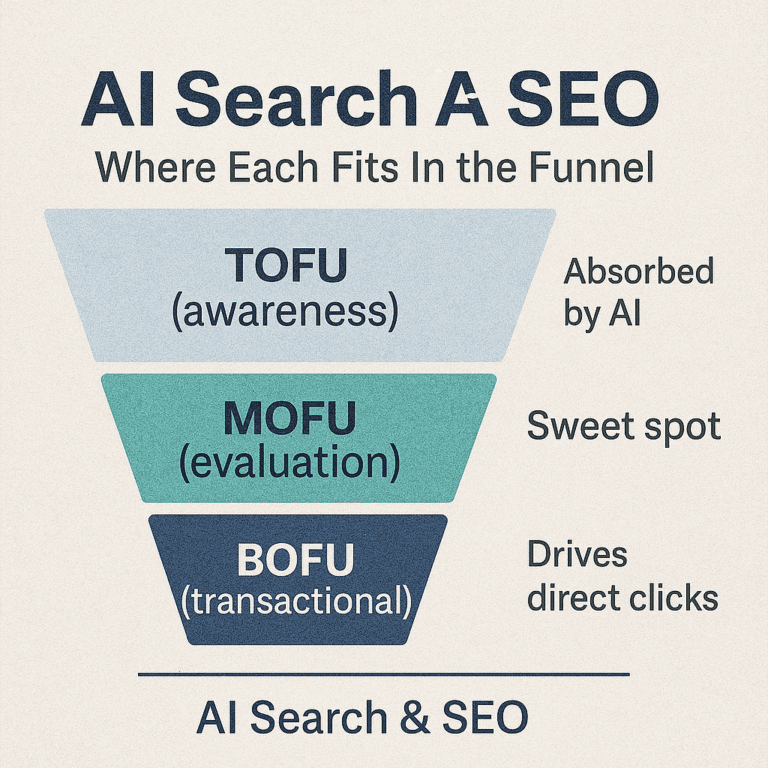
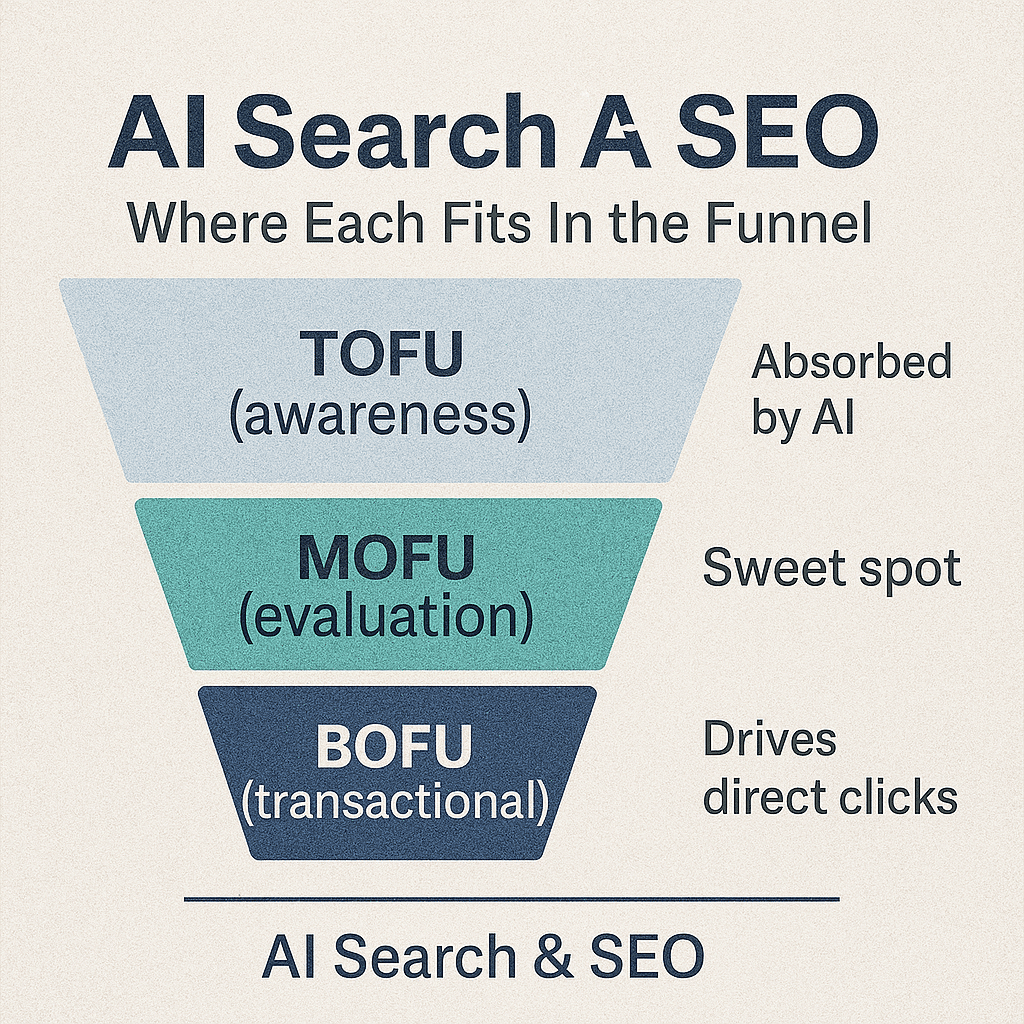
Funnel Shifts: Where AI “Eats” and Where You Should Invest
| Funnel Stage | What AI tends to absorb / summarize | What you should emphasize | Why |
| TOFU (awareness) | Definitions, FAQs, “what is …” | Clear, structured explainer content | Helps AI cite you, even if clicks drop |
| MOFU (evaluation) | Comparisons, use cases, case studies | Deep guides, thought leadership, product comparisons | This is where AI needs nuance and where your brand can shine |
| BOFU (transactional) | Rarely consumed by AI | Pricing pages, demos, testimonials | Users still click for decision-critical info |
Practical Steps for Marketers
- Track AI mentions alongside impressions and clicks.
- Audit your content mix, shift toward case studies, comparisons, and product guides.
- Use structured data and FAQs to increase AI and SEO parsing.
- Balance SEO + AI investments. Let SEO be your reliable growth engine and AI your credibility amplifier.
Final Thoughts
AI search is growing fast and reshaping discovery, but SEO still drives the majority of traffic across both e-commerce and B2B.
- For e-commerce, structured category pages, product guides, and reviews ensure you’re discoverable both in AI and traditional organic.
- For B2B lead gen, deep evaluative content and case studies help you surface in AI summaries and pull prospects into your funnel.
The right approach isn’t to abandon SEO for the shiny lure of AI, but to integrate AI mentions into your strategy, so you benefit from both authority and traffic.
References
- Glenn Gabe, GSQi — AI Search Currently Drives Less Than 1% of Traffic To Most Sites
https://www.gsqi.com/marketing-blog/ai-search-traffic-compared-to-google/ - Search Engine Land — AI Discovery Up 527% YoY
https://searchengineland.com/ai-traffic-up-seo-rewritten-459954 - Conductor — State of SEO in 2025
https://www.conductor.com/academy/state-of-organic-marketing/ - Digital Silk — Top SEO Statistics 2025
https://www.digitalsilk.com/digital-trends/top-seo-statistics/ - BreakTheWeb — AI Overviews Reduce Organic CTR by 20-40%
https://breaktheweb.agency/seo/ai-seo-statistics/ - SEMrush — AI Search SEO Traffic Study
https://www.semrush.com/blog/ai-search-seo-traffic-study/